Brain Works
This section of the Positivity Zone focuses on how the brain works. The physiological aspects of thoughts in the brain. Hence, the name Brain Works. Its purpose is to provide an understanding of the way the brain creates thoughts and emotions. Knowledge of this is important to improving and/or maintaining positive mental health.
“Scientists have learned more about the brain in the last 10 years than in all previous centuries because of the accelerating pace of research in neurological and behavioral science and the development of new research techniques.”
– Hara Marano, Editor, Psychology Today
Overview of Neurons
The brain contains about 100 billion nerve cells (neurons), which are the fundamental elements of the central nervous system. Neurons have three parts: the dendrites, the cell body, and the axon. These are shown in the image below. Neurons send and receive signals to neighboring neurons in the form of electrical pulses. Neurons receive signals through its dendrites. One neuron sends signals to another neuron through the axon. This happens in a fraction of a second. Suddenly, single neuron is connected to ten thousand other neurons.
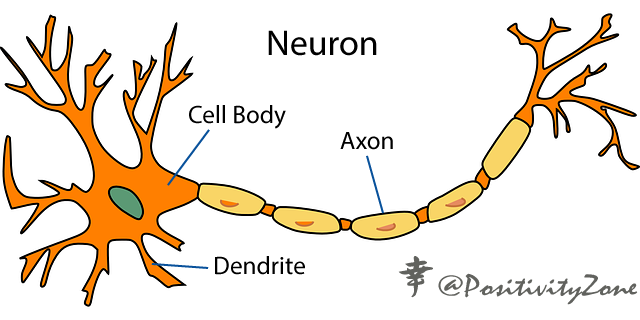
“All sensations, movements, thoughts, memories, and feelings are the result of signals that pass through neurons.” (National Institute of Health, 2003).
“External stimuli coming in the form of electrical currents from the sensory cells cause patterns of nerve impulses to be set up. These impulses can alter the strength of the coupling between different neurons. [Additionally], it is external stimuli which are crucially important in determining what network connections are made,” (Catterall, 2003).
Training Your Brain
Your way of thinking creates and reinforces the strength of the connections between certain neurons. These connections make up your thoughts. And you establish strong neuron connections that become easy for your brain to use, precisely because you use them repeatedly. Your brain doesn’t care if a thought or negative or positive. It only cares about the easiest pathway to follow.
If you think positive thoughts, your brain will create stronger connections (pathways) between those types of thoughts. You will have a tendency to have positive thoughts as that neuro network of positive pathways develops and strengthens. The same is true for negative thoughts. In other words, it is the frequency with which you use a particular neuron pathway that determines the strength (and therefore the recurrent use) of that pathway.
This explains why different people have different perceptions of an identical situation. It also explains why people tend to have either a glass-half-full or a glass-half-empty expectations regarding life in general. A person’s perceptions and expectations are a direct result of the strength between the neuron connections. When you work actively to develop other connections, you change the way your brain works. Accordingly, you change your thought bias!
Compelling Evidence
The most compelling evidence of this is when you purchase a new item. It doesn’t matter if it’s a car, a sweater, or anything else. Suddenly, you see that type of car everywhere. You see others wearing the same color or style of sweater. This is because you spent a lot of time thinking about that specific car or sweater. As a result, your brain created superhighways around that object. Suddenly, you recognize that object more easily.
“The process of perception links people to their environment and is critical to accurate understanding of the world about us… Yet research into human perception demonstrates that the process is beset by many pitfalls. Patterns of expectations [and perceptions] tell [people], subconsciously, what to look for, what is important, and how to interpret what is seen. These patterns form a mind-set that predisposes [the person] to think in certain ways. A mind-set is akin to a screen or lens through which one perceives the world,” (Central Intelligence Agency, 1999).